
How to Earn ~9% APY with MEV Rewards in Liquid Staked ETH


Before we get started, this is not a recommendation or endorsement to buy any token mentioned.
During another rough week in the crypto markets, we saw a surge of activity in DeFi and hence more demand to transact among DeFi users, raising gas prices on Ethereum Mainnet and other L1s and L2s. Normally during a market drawdown, traders will scramble to deleverage or make other moves to capitalize on the market volatility. As markets reacted to the fall of FTX and SBF’s criminal collapse, the gas price on Ethereum rose to the highest median price in the last 90 days.

Source: Dune Analytics
Since The Merge, there’s been a revamping of economics of how Ethereum transactions are settled. MEV (maximal extractable value) is still focused on the insertion of transactions (ordering, censorship, hijacking). However, there are new actors involved in the process. While miners secured the network under Proof-of-Work before The Merge, Proof-of-Stake Ethereum relies on validators.
To participate as an Ethereum validator, one needs 32 ETH to stake. Validators propose new blocks, submit attestations (votes), and monitor for any slashable offenses (penalties). Validators are who ensure the Ethereum network is secure and healthy.
Validators receive ~1700 ETH per day split between them, which varies based on the total amount staked by all validators and thanks to EIP-1559, they receive the Priority Fees that are “tipped” via transaction activity. While the majority of MEV used to accrue to miners under PoW, now with PoS, this MEV is captured by validators.
Related Articles

Stablecoin Farming: Earning 51% APR With New USD0 by Usual Money
Start earning yield with USD0 as well as points in the form of Usual Pills!
DeFi Farming with FBTC: A New Omnichain 1:1 Tokenized BTC
Get started earning with FBTC-powered DeFi!

Understanding How Index Coop’s Leverage Tokens Work for ETH and BTC
This week, we deep dive into automated leverage tokens by IndexCoop for those looking to gain more exposure to ETH or BTC, without having to worry about liquidations or funding rates.
Symbiotic Airdrop Strategy: Earning Points with weETHs Liquid Vault
Start earning an estimated 2.9% APY with weETHs along with points towards a Season 3 ether.fi airdrop, and future airdrops for Symbiotic and Veda.
Exploring DeFi on TON: Lending on EVAA Protocol
How you can earn passive yield lending to borrowers on EVAA and potentially a future airdrop!

INIT Capital Airdrop Strategy: Mantle’s Top Money Market
How to earn passive lending yield while accumulating INIT points towards a future anticipated INIT token airdrop.

Karak Pendle Strategy: Earning 22% Fixed APY with eETH
Take advantage of the demand for Karak YTs and buying Karak Pendle PTs to earn a fixed yield with my ETH.
Double-Digit Passive Yields: Leverage Strategy Vaults by Contango
Earn close to 50% APY with a Contango Strategy, thanks to the underlying yield of a popular Pendle eETH PT expiring June 24, 2024 on Arbitrum.

Leverage For Dummies: Earning Triple-Digit Yield with Origami Finance
Today, I’ll show how I can get maximum exposure to yield-bearing tokens such as sUSDe on Origami and earn maximum yield + points!
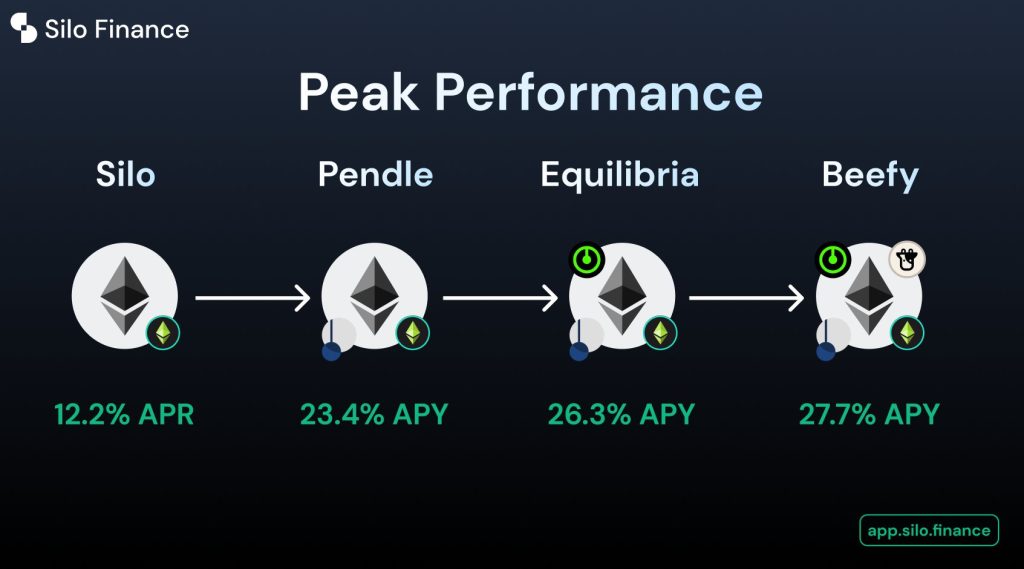
Beefy Finance Strategy: Earning Up To 47% APY Auto-Compounding Pendle ETH LP Yield
How you can start earning an estimated 47% APY with this four-part automated yield farming strategy for ETH, on Arbitrum.