ZkSync Era: the First Layer 2 on Ethereum with Zero-Knowledge Technology

TL;DR In the crowded space of Layer 2’s on Ethereum, ZkSync is a fresh entrant. A month after launch it is already in third position counting Total Value Locked, partly because of the expected airdrop. ZkSync Era has bet on zero-knowledge (zk) technology as the key requirement for onboarding hundreds of millions of users to Web3 without compromising security.
View zkSync Era as a Layer 2 ‘scaling and privacy engine’ for Ethereum, based on zero-knowledge proof technology. It is the first Layer 2 of its kind to launch – beating Polygon’s zkEVM by four days. Both are so-called zero-knowledge rollups that allow for faster and cheaper transactions while maintaining a high level of security. How does zkSync Era compare to other L2s?
Let’s take a step back for a moment. What is a Layer 2 (L2) on Ethereum? The second layer helps to offload work from Ethereum. While the assets remain on the Ethereum main chain, computation and transaction storage happen on the layer on top of Ethereum. This should give a high transaction rate while keeping the underlying safety of the Ethereum main chain.
ZkSync is Third in TVL
As with Arbitrum’s launch and subsequent airdrop, it’s no surprise that zkSync has seen a huge surge in activity. In fact, zkSyncEra now has the third largest total value locked ($260 million) among Layer 2’s that settle on Ethereum.
So, will this huge activity fizzle out after the airdrop? Not necessarily. Arbitrum has been going strong after its airdrop.
Delphi Digital tried to assess which of the current top 3 L2s (Arbitrum, Optimism, and zkSync Era) is the most profitable. They took the spread between the fee revenue generated by the L2 and the price the L2 pays to the L1 (L1 call data security costs), plus the verification costs for zk-rollups. It turns out that Arbitrum is the most profitable L2. For zkSync Era, Delphi argues the launch is too recent for a meaningful comparison. But it’s a metric to keep an eye on in the coming time, as demand for L2s will surge.
Difference Between Zk-rollups and Optimistic Rollups
A competing type of Layer 2 on Ethereum is called optimistic rollups. The current dominant L2s – Arbitrum and Optimism – are both optimistic rollups. Coinbase’s Base is another example. The ‘optimism’ part of optimistic roll-ups refers to the ‘optimistic’ assumption that transactions are valid until proven otherwise. But for the finality of transactions, you’ll have to wait a week or so on optimistic rollups. In contrast, on zero-knowledge rollups, you have near-instant finality, and you can bridge much faster back to Ethereum or to other rollup chains.
Zero-knowledge proofs in crypto are important for two reasons: privacy and data compression. Imagine that I can prove that I am the legitimate owner of a valid passport, without showing my passport to the clerk at customs, or to the car rental agency. Similarly, zero-knowledge proof technology enables cryptographic algorithms for verifying claims regarding the possession of data without having to reveal the data.
The Origin of ZkSync and ZkSync Era
The founders of Matter Labs, the company behind zkSync, viewed the scalability problem in Ethereum as the major hurdle standing in the way of adoption – until they discovered the existence of zero-knowledge proofs, and more specifically zk-snarks. The latter compresses computational structure into very short proofs that can be verified quickly.
ZkSync was launched in June 2020. Its iteration zkSync 2.0 was rebranded to zkSync Era and launched on March 24, 2023.
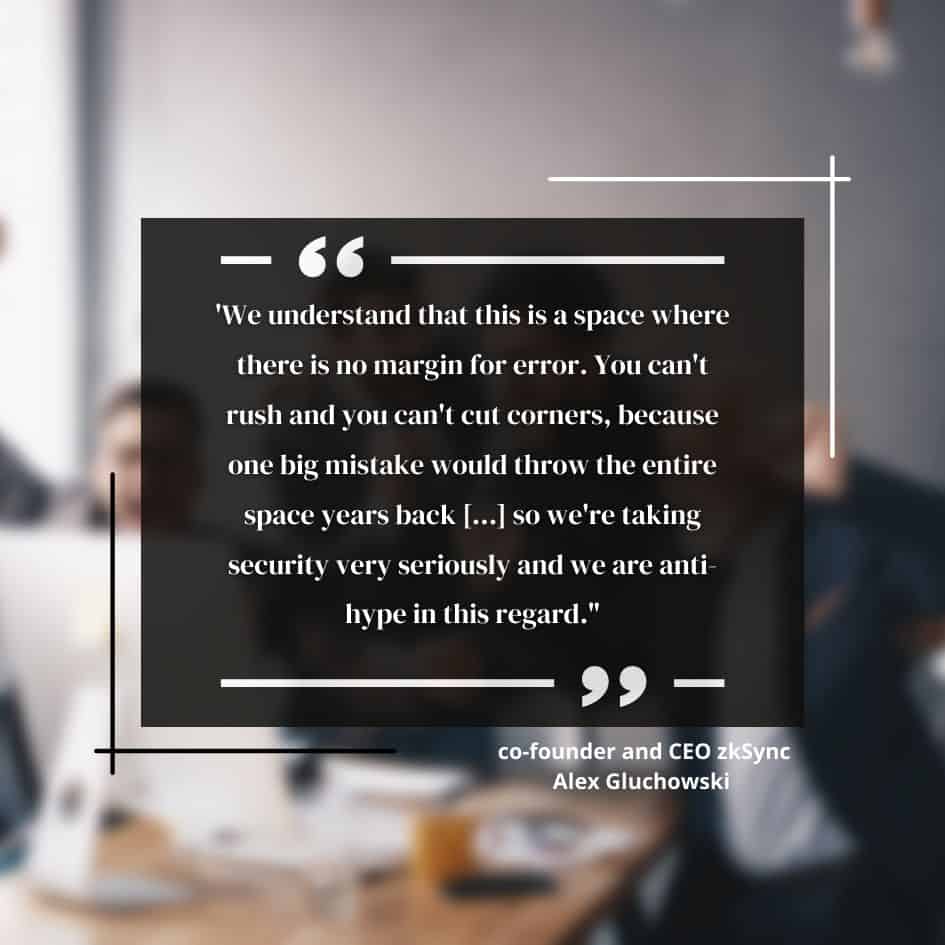
Matter Labs’s headquarters are in Berlin and its co-founder and CEO Alex Gluchowski keeps a rather low profile. That is intentional. In an interview with the Bankless podcast, Alex said:
‘We understand that this is a space where there is no margin for error. You can’t rush and you can’t cut corners, because one big mistake would throw the entire space years back […] so we’re taking security very seriously and we are anti-hype in this regard.”
Comparing Polygon’s ZkEVM with ZkSync Era
Polygon’s zkEVM launched only four days after zkSync Era. Both networks use zero-knowledge rollups. Interestingly, the Total Value Locked of zkSync Era was two orders of magnitude higher than Polygon’s at the time of writing (mid-April 2023). The likely reason is that the zkSync Era users are speculating on an airdrop – more on that below. Polygon, on the other hand, already has a token (MATIC) and has no allocation for a zkEVM airdrop.
The number of transactions on zkSync also outperforms that of Polygon’s zkEVM. The first averaged 5 transactions per second in the first few weeks, versus only one transaction per 20 seconds for Polygon’s zkEVM, per a research article in The Defiant.
More Than Just Higher Throughput and Lower Costs
With zk-rollup chains like zkSync Era, limitless scaling is on the horizon. Its instantaneous nature combined with increased composability – anyone can take existing functionality and build on top of it – will hopefully create an explosion of use cases.
In other words, L2s like zkSync Era are not just about increased transaction throughput and lower transaction costs. They are not just about making the horse faster, they are about creating an automobile industry. More oracles will become viable, more use cases will become viable. Account abstraction becomes viable. There can be cross-zk-EVM composability.
If we give the zkSync Era bulls their time in the sun, chains like zkSync Era hold the promise of transforming Ethereum into the internet of value for the entire world. From its current clunky ‘mainframe’ appearance, Ethereum could become a more accessible, user-friendly platform.
How Low Can Gas Fees Go?
According to the builders, zkEVM technology could make significantly lower gas fees possible compared to optimistic rollups. For some transaction types, the fees may be comparable. But for others, users might pay zero fees because contracts can subsidize these transactions. This is possible with native support of zk-tech for account abstraction.
How to Get a Potential ZkSync Era Airdrop
- Bridge funds to zkSync.
- Use dApps like Zig Zag to make a trade, Syncswap to provide liquidity, buy or sell an NFT on Mint Square, and do all kinds of stuff on SpaceFi.
- Do this consistently over time say at least once per month.
Maverick is another dex that might do an airdrop.
Mute Exchange
You can also play with swapping on the Mute Exchange: one of the few operational dapps on zkSync so far.
ZigZag Dex
ZigZag is a DEX built on zkSync and Starknet that has announced the upcoming launch of its new ZKAS token. An obvious airdrop opportunity.
Increment
Increment is a decentralized, algorithmic perpetual swaps protocol on zkSync 2.0, featuring automatically concentrated liquidity.
ZkSync Name Service
Another thing worth mentioning is zkSync’s Name Service, the first naming service on the zkSyncnetwork,powered by LayerZero. It will offer users the same domain services as Ethereum Name Service and similar projects. While no official airdrop has been announced, the community suspects that there will be incentives for purchasing a LayerZero .zk domain name. To have a chance at a future airdrop, you can Purchase Your Domain for as little as $5. Owning a domain would also make you eligible for any future LayerZero airdrops.
Conclusion
The L2 on Ethereum space is on fire. We like competition and the zkSync Era team mentioned they welcome it too. They seem to be a team that really cares about the mission of ‘scaling freedom’. In terms of adoption, they’re on the right track, considering the successful launch and the soaring number of users in the first month. Also, the bet on zero-knowledge technology, which they took years ago, seems to have been a smart one. The view that zero-knowledge tech is ‘the future’ is currently widely shared.
 TOP RECOMMENDED CRYPTO SERVICES
 BINANCE: BEST EXCHANGE FOR BUYING CRYPTO IN THE WORLD
 10% OFF FEES & $600 BONUS
 BYBIT: #1 EXCHANGE FOR TRADING 0% SPOT FEES AND $4,450 IN BONUSES
 BEST CRYPTO WALLET TO KEEP YOUR ASSETS SAFE BUY LEDGER WALLET HERE
💻 BEST CRYPTO TAX SOFTWARE ON THE INTERNET GET COINLEDGER NOW
 BITGET: BITGET IS YOUR TICKET TO SEAMLESS AND REWARDING TRADING EXPERIENCES!
 $30,000 IN BONUSES