Before we get started, this is not a recommendation or endorsement to buy any token(s) mentioned.
Fixed-rate lending is a fundamental building block of modern finance, offering a predictability and certainty to enterprises and households as it relates to their debt or rate of return. In traditional finance, debt markets are the largest financial market in the world, with total outstanding debt in 2021 for the US alone at $88 trillion vs just $42 trillion for U.S. equities, a large majority of which is fixed-rate debt.
In DeFi, lenders and borrowers remain mostly reliant on variable interest rates like we find on DeFi money markets like Aave or Compound. These rates have plummeted during the crypto bear market but then violently spiked for ETH leading up to the transition to Proof of Stake in September 2022 and more recently the Shapella Upgrade, which enabled withdrawing staked ETH from the Beacon Chain. DeFi variable rates can often be driven by newsworthy events and while lenders might enjoy that spike in rates, it’s very unsettling for borrowers and yield farmers looking for more predictability in on-chain borrowing rates. DeFi lenders and borrowers are required to make certain trade-offs that give rise to this lending trilemma, where they are forced to pick between stability, scalability, and transparency.
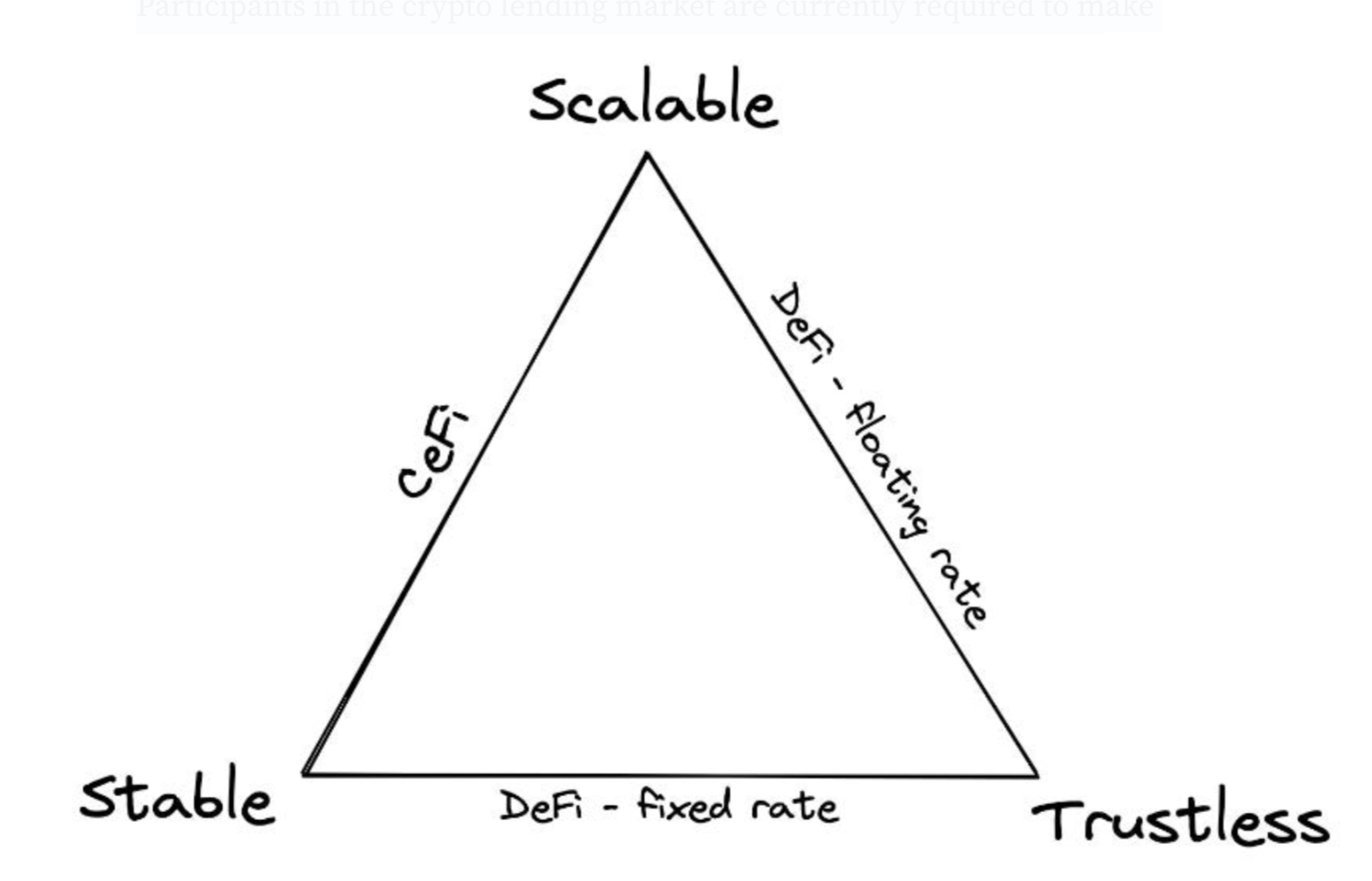
Until now! Term Finance introduces a new DeFi primitive with fixed rate lending and borrowing via on-chain auctions, modeled on tri-party repo arrangements common in TradFi. Term Finance is a noncustodial, scalable fixed-rate lending protocol. With Term, users can access liquidity on fixed terms without compromising on fees, slippage or having to trust CeFi counterparties, who have clearly demonstrated how much we should distrust them this bear market (ie Genesis, BlockFi, Celsius).

Here’s how it works!
- Borrowers and lenders are matched through a unique recurring auction process (Term Auctions) where borrowers submit sealed bids and lenders submit sealed offers that are used to determine an interest rate that clears the market for participants of that auction.
- Participants who bid more than the clearing rate receive loans and participants willing to lend below the clearing rate make loans, in each case at the market-clearing rate. All other participants’ bids and offers are said to be “left on the table.”
- At the conclusion of an auction, borrowers receive loan proceeds and lenders receive ERC-20 tokens (Term Repo Tokens), which are receipts that lenders will burn to redeem for principal plus interest at maturity.
- Protocol smart contracts service these transactions by ledgering repayments and monitoring collateral health and liquidations.
In the past month, during a whitelisted guarded launch, the Term Finance team has successfully run 4 auctions pairing lenders and borrowers for 4-week loans, issued in USDC, while borrowers are overcollateralized 150% to start with wstETH deposits, and required to maintain 125% overcollateralization until their loan is paid back. The result of their “market clearing rate” after all offers (lending) and bids (borrows) are submitted are as follows for these 4-week term loans listed here:
June 29th: 3.5%
July 13th: 3.27%
July 20th: 3.3%
July 27th: 3.27%
Check out the key details from the last auction settled on July 27th, 2023.
DeFi Dad is one of the earliest power users of DeFi, having worked with early Ethereum startups going back to 2018, including Zapper.
- Get expert insights and clear analysis to help you stay ahead of the crypto market.
- Discover high-potential opportunities across Bitcoin, DeFi, altcoins, and emerging narratives.
- Avoid costly mistakes with simplified, actionable updates delivered each week.