Launched in 2016, Zcash (ZEC) was the first privacy coin to use zero-knowledge proofs to guarantee transaction privacy. Zcash is moving to Proof-of-Stake (PoS) in the coming years. Let’s have a look at why this prominent privacy coin has decided to move away from good old Proof-of-Work. Is this part of a larger trend?
The Merge Inspires Other Coins
Ethereum’s successful Merge may not have done great things for the price (yet?) but its impressive transition to PoS is making waves. Not a tsunami maybe, but a slowly rising tide of coins that are currently Proof-of-Work (PoW) who want to dip their toes in looking into a transition to Proof-of-Stake. There are rumors (heavily disputed) that Dogecoin might make a similar transition (see below).
It is not just conjecture that Ethereum’s transition is inspiring other coins to transition. Co-founder of Ethereum Vitalik Buterin even encourages this development. Vitalik: “I hope that Zcash moves over. I am also very hopeful that Dogecoin is going to evolve over to PoS at some point soon. As PoS matures I would expect it to increase in legitimacy over time.”. Buterin expressed this view at Messari Mainnet 2022.
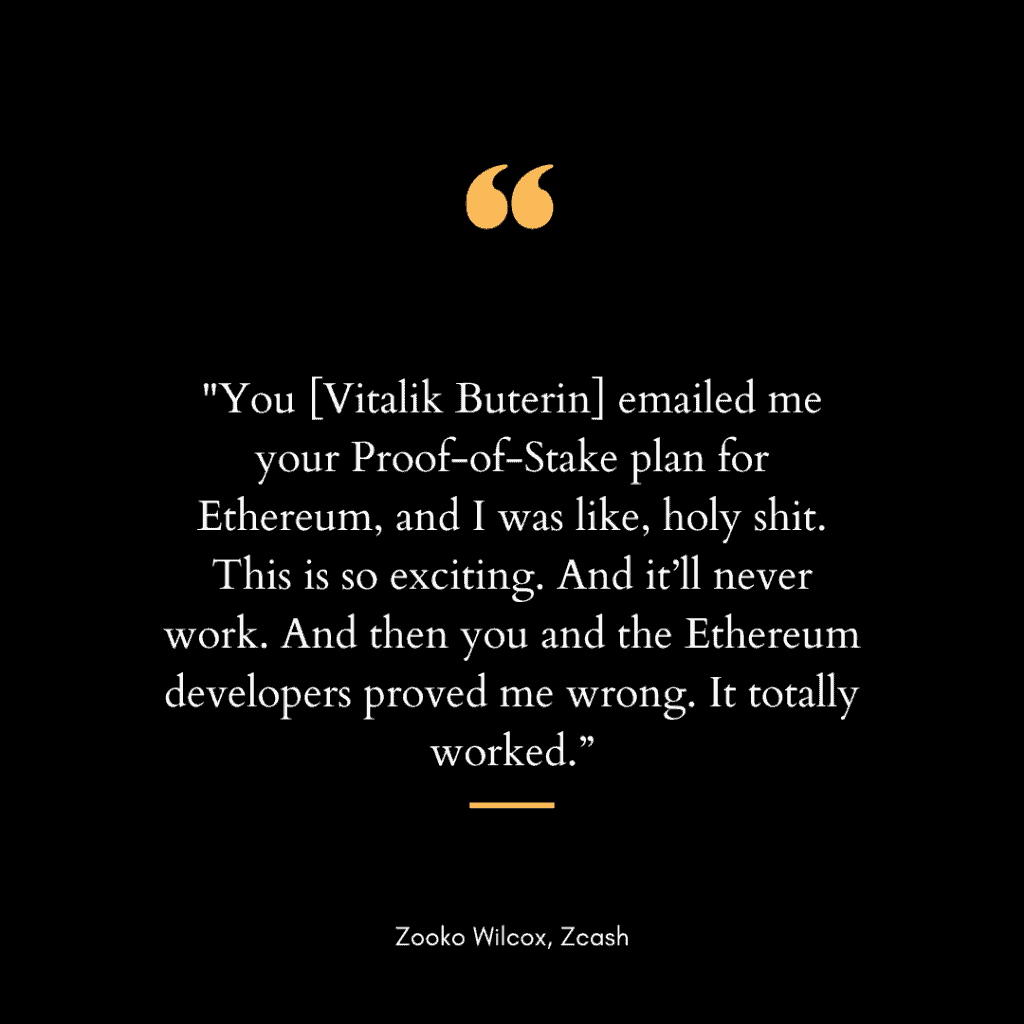
Zooko Wilcox, CEO of the Electric Coin Company that oversees Zcash’s development, has echoed this sentiment. At the same conference, he admitted the Zcash Foundation had been eager to see what they could learn from Ethereum and were positively surprised (see quote above).
Why Do Coins Move To Proof-of-Stake?
After the first five years post Bitcoin’s launch saw many new coins that forked off Bitcoin, with some design changes. These coins, such as LiteCoin and Bitcoin Cash, used PoW as a consensus mechanism, just like Bitcoin. But they altered some parameters such as block size, or added new functionality altogether, such as privacy in the case of Zcash.
Why Proof-of-Work? PoW is a great and fair way to bootstrap a new currency. Mining costs are so low that ordinary users can still be a miner.
Once a coin is properly distributed though, the issue of centralized control is mostly solved: the project has made sure that it’s no longer a small group of insiders who own all the coins. At that point, PoS becomes a reasonable option for the fairly distributed owner base. It allows holders to put their coins to use. By staking it, they secure the network and get yield in return.
What is Zcash?
ZCash (ZEC) is a Bitcoin fork from 2016 with a different hashing algorithm and privacy protocols. It uses zk-SNARK (a type of zero-knowledge proof technology) to ensure that no information from parties involved in a transaction is revealed to each other or the network.
Zcash is one of the big privacy coins, besides Monero. It has the same 21 million cap as Bitcoin and had used PoW as a consensus mechanism since the beginning. In the first four years, 9.85% of the mining rewards went to the founders. This controversial tax of sorts was abandoned in 2020 when Zcash rolled out a major upgrade: Canopy. The Electric Coin Company, which oversees development, is still funded by a small percentage of mining rewards.
Zcash’s Move
Zooko Wilcox-O’Hearn, CEO of the Electric Coin Company, personally endorsed a switch to proof-of-stake in that announcement. Why?
Why Zcash’s Switch to Proof-of-Stake?
It’s good for the price… As Zooko Wilcox readily admits, Zcash needs a solid price to keep being attractive and to keep aiming at their mission of ‘enabling social freedom for everyone’. Miners selling Zcash puts pressure on Zcash’s price.
Other reasons for the switch to PoS:
- Zcash doesn’t like to be associated with ‘boiling the oceans’ (PoW energy costs).
- They believe that Proof-of-Stake offers better security at lower costs.
- Their use of a platform such as the Cosmos stack brings with it the option to make ZEC more interoperable across chains.
- Industrial-grade Zcash mining made Zcash lose a lot of their retail miners/users: “We experienced the impact of the introduction of ASICs miners to Zcash in 2018. The amount of activity on the Zcash chain quickly dropped by 80% as many Zcashers were forced to abandon their GPU miners as their means for acquiring ZEC.”
Roadmap
In Zcash’s roadmap for 2022-2025, the transition to PoS is now an official goal post. The transition would probably take two or more years. There will be a transitional phase: a hybrid PoW-PoS protocol, prior to any move to complete PoS. They are confident that switching to PoS would not alter the Zcash issuance rate or 21 million cap.
Dogecoin’s PoS Rumours Denied
Maybe because of Vitalik’s quoted remarks rumors started floating around that Dogecoin would abandon PoW. Dogecoin developers have denied the rumors that there are plans to move the network to proof-of-stake, sparked by Vitalik’s comments. Warnings to miners started circulating on YouTube not to invest in Dogecoin mining gear.
Bitcoin Next? Not So Fast
As Dogecoin and Zcash are both Bitcoin forks, their possible move away from Proof-of-Work raises the question if Bitcoin will ever take the same path. Whereas PoW is an excellent way to distribute coins in the early innings (a few years) after a coin’s launch, the community is less involved once mining becomes more industrial and the mining rewards start running out. Also, there are lingering concerns for Bitcoin’s ‘security budget’ a few halvings into the future. Will the block reward be sufficient to compensate miners for defending the network? Will a healthy fee market develop?

Andreas Antonopoulos has compared Ethereum’s move to PoS to ‘Chekhov’s gun’ for Bitcoin. The fact that Ethereum has shown it could successfully move from PoW to PoS, gives Bitcoin an alternative consensus mechanism of last resort.
Imagine a scenario where Bitcoin’s PoW would face government-scale attacks, for example by forcing all the miners to shut down or forcing them to censor transactions. Bitcoin could then switch to PoS. Ethereum has shown it is technically possible to make the transition and counter such an attack. Plus, the ‘plebs’ already own most of the coins ever to be issued: it’s in their interest to keep the chain honest and stake accordingly. Note that we don’t need to implement that solution for PoS to be an effective countermeasure against government attacks against PoW. Just like Chekhov’s gun, it’s simply hanging over the scenery to remind all players that an attack against miners will have consequences, and not the desired ones.
Chekhov’s gun always gets fired in the third act of his plays. That doesn’t mean that Bitcoin will move to PoS in its ‘third act’. On the contrary. Barring imminent threats as discussed above, it is quite likely that Bitcoin will remain Proof-of-Work. The more coins launch as PoS or move to PoS, the more PoW stands out as an alternative. Any marketeer will tell you that it’s vital to have a unique selling point like that. So it’s unlikely Bitcoin will make the jump unless forced by security and/or censorship issues.
What Zcash’s move does show is that there is nothing sacred about PoW. Many projects could simply view it as a stage in the life cycle of its consensus mechanism.
Erik started as a freelance writer around the time Satoshi was brewing on the whitepaper.
As a crypto investor, he is class of 2020. More of a holder than a trader, but never shy to experiment with new protocols.