What is Avalanche? | Avalanche Crypto Explained for Beginners

Written By
Jesse
First Published
May 18, 2022
Last Updated
May 2, 2023
Estimated Reading Time
1 minute
what is avalanche
In this article...

What is Avalanche?

Avalanche is a “semi”-permissioned blockchain that bridges siloed public and private blockchains together to enable two things at once. It was designed to be customizable, scalable, and interoperable.

Everything on Avalanche is a subnet, and every chain is part of a subnet. Their consensus protocol was inherently designed to be immune to any type of 51% attack. In order to gain control of the network, an entity would need to acquire 80% of the network’s validators in order to influence such control.

Unlike other blockchains, the digitization of assets on Avalanche can obey special covenants, making it a suitable solution for adhering to legal compliance.

Use cases that the team are developing include Private Securities, ILOs, DEX’s, Synthetics, Stablecoins, Prediction Markets, Equities, Bonds, Debt, and Real Estate.

How did Avalanche Begin?

Avalanche $AVAX was founded by Dr. Emin Gun Sirer, a well-known expert on blockchains and digital currencies. Dr. Sirer is best known for his creation of a peer-to-peer, proof-of-work digital currency called Karma in 2003, six years before the “Bitcoin” whitepaper was released. 

Dr. Sirer has taught distributed ledger technology at Cornell University for over two decades. It’s here that the idea for Avalanche was created with a dozen other Cornell Alumni.

After theory and testing, Avalanche was launched in September 2020 after raising $60 Million in initial funding. $AVAX has a maximum supply of 720 Million, of which more than half are locked into the network for “Staking”.

How does Avalanche Work?

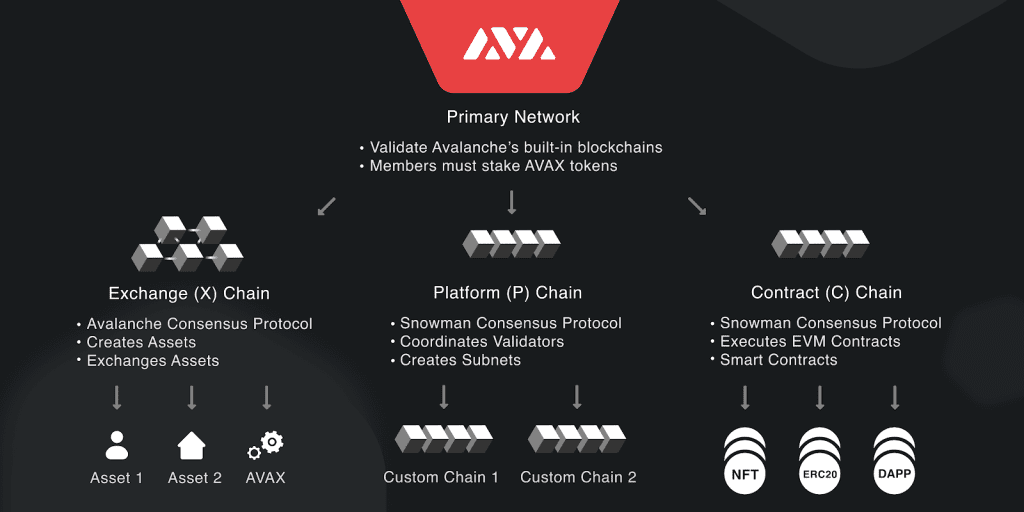
Avalanche is split into three separate blockchains that are combined to create the Avalanche Primary Network:

  1. The Platform Chain (P-Chain): The metadata chain. It coordinates validators, keeps track of active subnets, and allows for the creation of new subnets using the Snowman consensus protocol.
  2. The Exchange Chain (X-Chain): The default asset chain. It enables the creation of new assets, exchanging between assets, and cross-subnet transfers using the Avalanche consensus protocol.
  3. The Contract Chain (C-Chain): The default “Smart Contract” chain. It enables the creation of any Ethereum-compatible smart contracts using the Snowman consensus protocol.
avalanche crypto

Key Milestones for the Team

In November 2020 the Avalanche-Ethereum “Bridge” was completed, using ChainBridge as a two-way token bridge that enables seamless transfers between Avalanche and Ethereum. This enabled the full use of $ETH within decentralized applications on Avalanche by locking $WETH in the ChainBridge contract to mint an equivalent token on Avalanche. Through this, the Avalanche-X program was created in order to fund future development proposals put forth by the community.

Avalanche Protocol includes a burning mechanism that burns all fees collected using their platform. Soon they will introduce Quantum Resistance and Privacy Sub Networks in a future update of the protocol. Avalanche has partnerships in place with Reef Finance, SushiSwap, TrustSwap, Simplex, TrueUSD, Injective Protocol, Bitpanda, OKCOIN, Aleph.im, e-Money, bZx, Ankr, Bitfinex, and dozens of other top-quality projects.

Head of Research Jesse is a passionate seeker of truth who enjoys educating others about Bitcoin. As a free thinker and 2nd amendment advocate, Jesse believes each individual has the right to monetary freedom. “The swarm is headed towards us” -Satoshi Nakamoto

Discussion on "What is Avalanche? | Avalanche Crypto Explained for Beginners"
You must Subscribe or Login to post a comment.
Additional Resources
Subscribe Today!
Join Thousands Getting Free Insights

Join 190,000+ Investors Getting Free Insights

Privacy Policy

Who we are

Our website address is: https://larkdavis.org.

Comments

When visitors leave comments on the site we collect the data shown in the comments form, and also the visitor’s IP address and browser user agent string to help spam detection.

An anonymized string created from your email address (also called a hash) may be provided to the Gravatar service to see if you are using it. The Gravatar service privacy policy is available here: https://automattic.com/privacy/. After approval of your comment, your profile picture is visible to the public in the context of your comment.

Media

If you upload images to the website, you should avoid uploading images with embedded location data (EXIF GPS) included. Visitors to the website can download and extract any location data from images on the website.

Cookies

If you leave a comment on our site you may opt-in to saving your name, email address and website in cookies. These are for your convenience so that you do not have to fill in your details again when you leave another comment. These cookies will last for one year.

If you visit our login page, we will set a temporary cookie to determine if your browser accepts cookies. This cookie contains no personal data and is discarded when you close your browser.

When you log in, we will also set up several cookies to save your login information and your screen display choices. Login cookies last for two days, and screen options cookies last for a year. If you select “Remember Me”, your login will persist for two weeks. If you log out of your account, the login cookies will be removed.

If you edit or publish an article, an additional cookie will be saved in your browser. This cookie includes no personal data and simply indicates the post ID of the article you just edited. It expires after 1 day.

Embedded content from other websites

Articles on this site may include embedded content (e.g. videos, images, articles, etc.). Embedded content from other websites behaves in the exact same way as if the visitor has visited the other website.

These websites may collect data about you, use cookies, embed additional third-party tracking, and monitor your interaction with that embedded content, including tracking your interaction with the embedded content if you have an account and are logged in to that website.

Who we share your data with

If you request a password reset, your IP address will be included in the reset email.

How long we retain your data

If you leave a comment, the comment and its metadata are retained indefinitely. This is so we can recognize and approve any follow-up comments automatically instead of holding them in a moderation queue.

For users that register on our website (if any), we also store the personal information they provide in their user profile. All users can see, edit, or delete their personal information at any time (except they cannot change their username). Website administrators can also see and edit that information.

What rights you have over your data

If you have an account on this site, or have left comments, you can request to receive an exported file of the personal data we hold about you, including any data you have provided to us. You can also request that we erase any personal data we hold about you. This does not include any data we are obliged to keep for administrative, legal, or security purposes.

Where we send your data

Visitor comments may be checked through an automated spam detection service.

Boom! You're on the shortlist.

You just took the first step toward getting your project in front of one of the most engaged communities in crypto.
We're already diving into your details to see how we can best showcase your vision to our audience. You should hear from us within 2 business days to discuss strategy, availability, and next steps.
Let's build something legendary.

Join 190,000+ Investors Getting Free Insights