Farcaster: On-chain Social Media Protocol with Exploding User Growth

TL;DR
Activity on Farcaster has exploded in recent weeks. This decentralized protocol for social media apps lures in users with airdrops, and more fundamentally with the promise to no longer be a slave of traditional social media companies. Here, you own your account and content. The recent introduction of Farcaster Frames has introduced new possibilities for marketers: have users mint and buy stuff while staying in their timeline.
Farcaster was co-founded by former Coinbase executives Dan Romero and Varun Srinivasan. It is an open-source platform built on top of Ethereum for building decentralized social networks. If you have an Ethereum wallet, it’s a very low threshold to sign up.
Farcaster and its Kin
Farcaster will give you a censorship-resistant solution to control your own social media data and transport your ‘social graph’ across apps in its ecosystem. Any Alice or Bob could jump between different apps built on Farcaster while continuing to use their same identity. Your social identity is NOT saved on a central server of a social media company.
A lot of people liked this idea, apparently, and signed up in recent weeks (see graph below). This graph looks spectacular but realize that 40.000 daily users is a few orders of magnitude smaller than let’s say Twitter. Still, though…
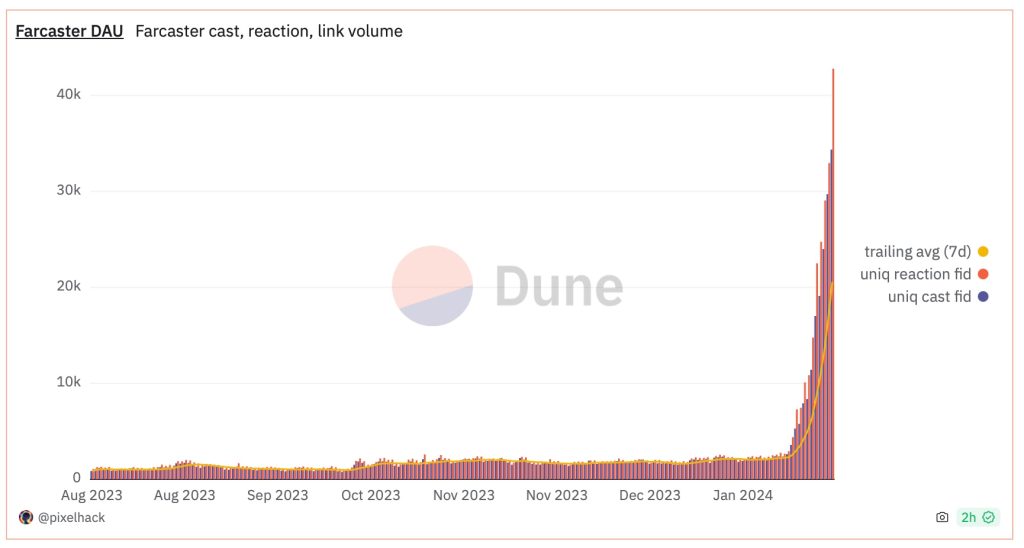
On Farcaster, you can send short text message broadcasts called casts. It’s similar to Nostr, in the way both platforms integrate crypto features such as wallet-based logins and transactions. Whereas Nostr is heavily populated by Bitcoin believers, Farcaster caters to Ethereum users.
Another ‘competitor protocol’ is Lens Protocol: also a decentralized social platform – but built on Polygon.
Another recent addition to the Decentralized Social App Ecosystem is Friend.tech. It burst onto the scene with its crypto-native version of super chats: you could buy the keys of your favorite people to get a hotline. It spiked in popularity but has petered out in recent months. You need to own quite a few ETH to get access to your favorite influencers and hence is considered quite elitist.
A Mix of On-chain and Off-chain Data Storage
Farcaster stores data partly on-chain, partly off-chain. It stores user identity information on-chain on Optimism mainnet while storing data on posts and interactions off-chain.
The actions that are executed on-chain are:
- Creating an account
- Paying for your account ($5)
- Adding account keys (or giving permission) to connected apps
Understandably, not all data are stored on-chain. There is no Ethereum-based chain that could store thousands of posts per second.
Instead, the posts, reactions, profile picture, etc are stored on a peer-to-peer network of servers called Hubsthat store user data. The user actions that are performed off-chain include:
Farcaster uses the Ethereum Name Service (ENS) to manage account usernames.
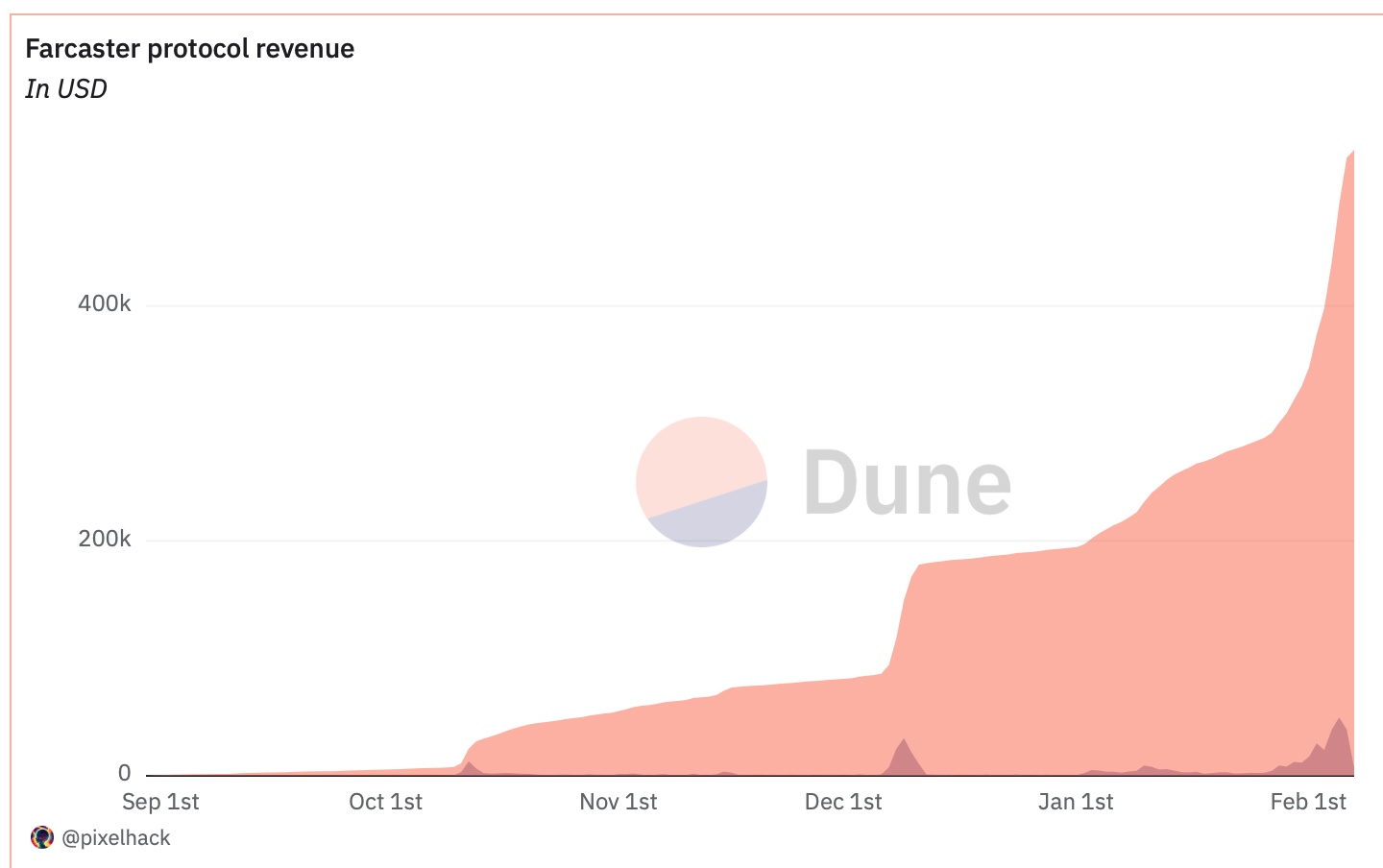
Warpcast: Most Popular App on Farcaster
Farcaster wants you to sign up for the platform using Warpcast. Warpcast is a Twitter-like app built on Farcaster. It’s often confused with Farcaster itself. But remember, Farcaster is the protocol and Warpcast is an app. Warpcast is to Farcaster a bit like what Gmail is to the SMTP protocol.
Here is how you can use Farcaster using Warpcast:
- Download the Warpcast app on the App Store or Google Play Store.
- Create an account.
- You will have to secure the secret recovery phrase for your wallet.
- Enter your email address and verify it.
- Pay a $5 per year fee to create your Farcaster account on Warpcast. (deducted from your Apple App Store or Google Play Store balance).
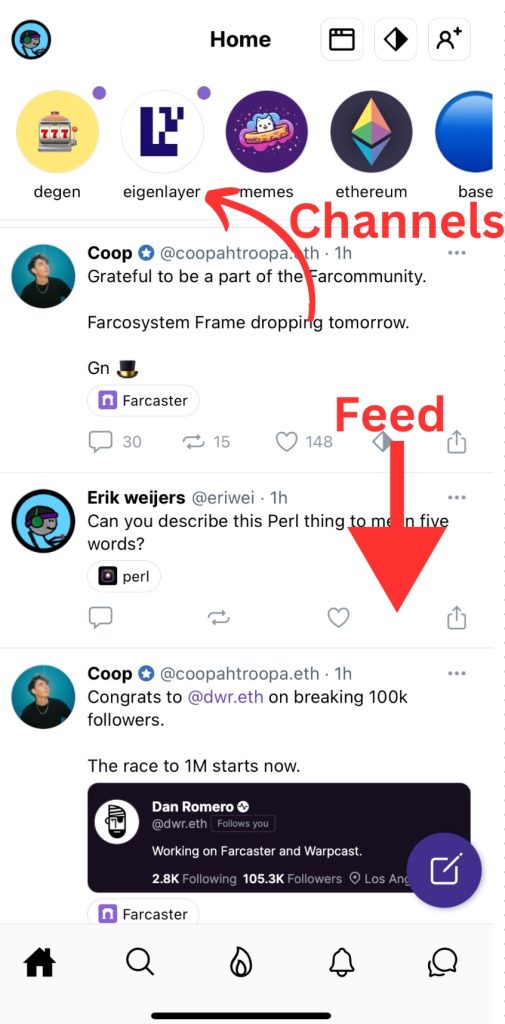
As you can see from the screenshot of the Warpcast app, it has a feed similar to Twitter and Channels similar to Reddit. Some popular channels are Ethereum, Memes and Degen (more on Degen below). Warpcast can be used as a mobile app or as a desktop app.
Some Other Apps on Farcaster
Warpcast is by far the biggest app on Farcaster: it takes up about 45% of transaction volume. There are tons of other apps though, popping up left and right. Let’s look at a few noteworthy ones:
- Paragraph: a newsletter publishing platform. It helps writers build a community using features such as NFT memberships and token-gating.
- Frens: A decentralized messaging app for secure and private on-chain communication.
- Icebreaker: a network to make professional connections, ‘Farcaster’s LinkedIn’
Frames Keep Users on Farcaster
Farcaster recently implemented “frames,” which are embeds that can feature interactive buttons and enable users to respond. Frames make it easy to do things like participate in polls, and subscribe to newsletters. But also, minting NFTs. Imagine minting an NFT and not having to leave your timeline!
This seems ‘just nice’ but could be revolutionary. Farcaster Frames allows any app to embed a frame within Farcaster. With Farcaster Frames, users can stay on the platform while interacting with various content. It’s any marketer’s dream, in fact. Just post a product offer as a frame in a Warpcast channel and interact with users who are logged in… with their wallets! Frictionless commerce, people!
So you could say that Farcaster Frames bridge the gap between the attention economy (consuming content on social media) and the e-commerce economy (spending online). Businesses will be able to engage users and drive transactions in the same environment. It will be interesting to see what new marketing strategies will pop up.
Degen Airdrop on Warpcast
Degen is an in-app currency for Warpcast that has already been partially airdropped in round 1. Users can tip each other with this $DEGEN coin. The more active you are, the more DEGEN Warpcast will reward you.
There is a second DEGEN airdrop coming. You can qualify in the following way:
- Connect your wallet to Farcaster.
- Post at least 3 original casts on Farcaster.
- Wait 24 hours for activation.
Read more on the second phase Degen airdrop on Degen.xyz.
Conclusion
Of course, it remains to be seen if Farcaster will form any threat against the centralized social media dinosaurs. To disrupt the status quo, a new platform needs to come with an edge that makes it an order of magnitude better than the incumbents. Farcaster has not one but two of these potential step changes in functionality. First, the flywheel effect of an in-platform coin that is being airdropped. And second, the invention of frames removes the friction between transaction interfaces and the timelines of social platforms. This was the plan all along. In crypto, there is no fundamental difference between the flow of money and the flow of data. It’s all money/data lego.
 TOP RECOMMENDED CRYPTO SERVICES
  BINANCE: BEST EXCHANGE FOR BUYING CRYPTO IN THE WORLD
 10% OFF FEES & $600 BONUS
 BYBIT: #1 EXCHANGE FOR TRADING 0% SPOT FEES AND $4,450 IN BONUSES
 BEST CRYPTO WALLET TO KEEP YOUR ASSETS SAFE BUY LEDGER WALLET HERE
💻 BEST CRYPTO TAX SOFTWARE ON THE INTERNET GET COINLEDGER NOW
 BITGET: BITGET IS YOUR TICKET TO SEAMLESS AND REWARDING TRADING EXPERIENCES!
 $30,000 IN BONUSES