Babylon Chain: Staking Your BTC

TLDR: Babylon Chain will allow Bitcoin holders to stake their BTC without the need for third-party custody, bridging, or wrapping. Instead of rewards in BTC, Bitcoin stakers will receive their yield in the currency of the chain they secure. Babylon has successfully secured $18 million in funding and is currently in its testnet phase.
You are probably aware of the most common objection of traditional investors against Bitcoin, or gold, for that matter: this asset doesn’t collect yield. it just sits there doing nothing in your hardware wallet or safe…
While Bitcoiners will shrug their shoulders (‘Who needs 5% yield on an asset that goes up at least 50% a year?’) It is notable that the times they are a-changin: soon, adventurous Bitcoiners will be able to collect yield on their BTC – albeit paid out in coins from another protocol.
The protocol that will allow us to do this is Babylon Chain. It will allow you to stake your Bitcoin and earn yield. It lets BTC secure Proof-of-Stake (PoS) chains and decentralized apps (Dapps) through a Bitcoin Staking Protocol.
Before we dive into the machinery, let’s take a step back and look at what staking and re-staking is.

Staking and Re-staking on Ethereum
Keep in mind that staking is locking up and risking capital in return for yield. Instead of energy and hardware costs – as is the case with Bitcoin – in proof-of-stake protocols like Ethereum – it’s the joint staked capital that creates the game-theoretic equilibrium that keeps the network safe. Why? Validators (stakers) who behave badly get their stake slashed. Validators who behave well get a financial reward.
Now, since Ethereum moved to proof-of-stake in 2022, it has been smooth sailing. Ethereum has run flawlessly and the amount of staked ETH has been steadily climbing. Nothing to see there. Which is probably why a developer thought: why not make it a bit more exciting: let’s allow users to re-stake their ETH.
To explain, imagine you’re a billionaire and just bought an island. How to protect it from invaders? You could either fund and train an army or… become friends with a superpower like the United States. Ask if they could watch out for your coastline while they’re there anyway.
Now picture trying to build a new decentralized app. Instead of funding your own security budget… you could become friends with one of the superpowers, Bitcoin or Ethereum. These are the securest chains, so what if you could ‘borrow’ their security? For Ethereum, this mechanism is already almost fully operational and it’s called Eigenlayer.
A bit like the United States Navy can use the same vessel to protect both its shore and a friendly neighboring island nation, so Ethereum stakers can choose to stake their Ether a second time to a network they want to support. The same stake to secure the Ethereum network can be re-used to secure other networks. EigenLayer is the tech that intermediates.
You can stake in Ethereum and then also specify to the EigenLayer contracts that you allow your ETH to be staked a second time – and a third, and fourth, and… as many times as there are applications that invite you.
In just five months, EigenLayer has amassed over $13 billion in Total Value Locked (TVL). Given the attractiveness of this security model with ETH, why not apply the same approach to Bitcoin, an even more desirable and secure asset?
How Does Babylon Work?
As you probably know, the Bitcoin protocol consensus isn’t based on proof-of-stake. But as discussed, the security that the Bitcoin chain offers can be exported, as it were.
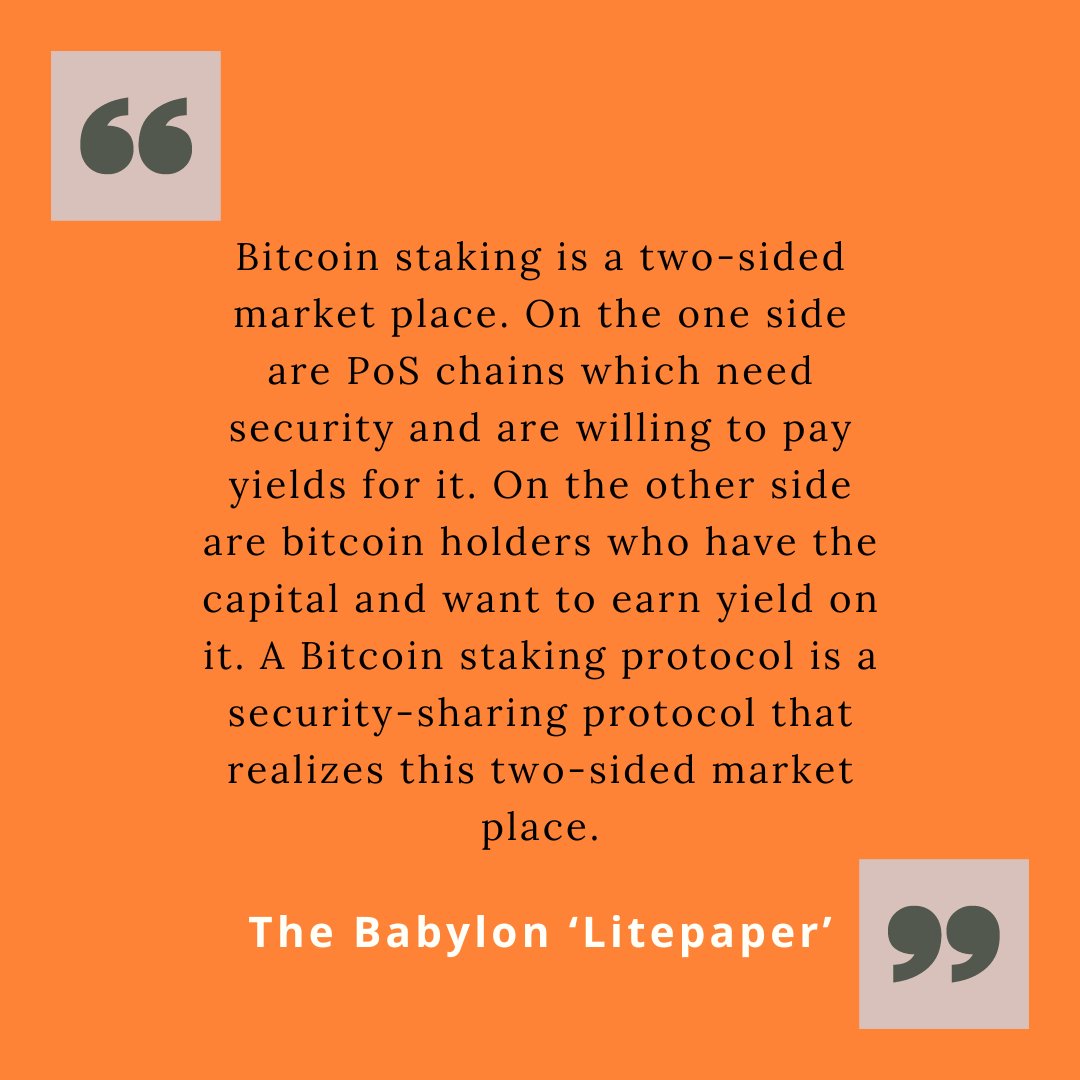
Like Eigenlayer, Babylon uses remote staking, in order to avoid having to trust third parties such as bridge providers or custodians. With remote staking, users can lock, stake, and slash a particular asset on its home chain, in this case Bitcoin.
Let’s say you are a BTC holder and you want to stake your assets. As mentioned, it’s currently on testnet. But when live, you can go to Babylon and select which network(s) you would like to stake towards. Then you lock up your BTC in exchange for yield in the other network’s token, which you can claim on the third-party network. That way you get to keep holding your BTC while earning additional yield.
The benefit to the proof-of-stake network? It inherits the economic security of Bitcoin.
Some features of Babylon:
- The stakers’ BTC is stored in a self-custodial vault with a time lock. It remains on the Bitcoin network. The stakers keep owning their private key. In case the staker misuses their stake to attack another network, their stake will be slashed.
- Babylon is the security bridge to the other protocol. It is also used to provide yield to BTC stakers, in the token of the other chain.
- Through the Babylon chain, the BTC stake is delegated to validators. The protocol used for communication is IBC, the Inter-Blockchain Communication Protocol by Cosmos.
- Timestamping on Bitcoin: Babylon collects staking and un-staking transactions from the other chain and checkpoints these to Bitcoin. This means the Bitcoin blockchain (‘time chain’) is the anchor. Timestamping also allows other chains to publish arbitrary data to Bitcoin and get timestamps in return, with which they can protect important transactions and synchronize networks.
Running a Babylon Validator, Potential Airdrop
Babylon testnet is currently live – check Babylon’s X account for updates. Using the testnet will potentially make you eligible for an airdrop. If you want to delve deeper, and be eligible for potentially much higher airdrop rewards, running a Babylon validator node is something to consider.
A Hot Narrative: Built on Bitcoin
The amount of projects currently being built on Bitcoin is impressive. Long gone are the days of boring ole orange coin!
A shortlist:
- BitVM (short for Bitcoin Virtual Machine): smart contracts on Bitcoin will make it possible to create and run complex smart contracts that settle on the Bitcoin blockchain. It will make the use case of Bitcoin extend far beyond peer-to-peer cash. In contrast with Ethereum, most of the processing in BitVM happens off-chain, making operations more efficient and unbothered by expensive blockspace.
- ZK-rollups on Bitcoin will allow for financial privacy. A zero-knowledge (zk) proof will for example make it possible to prove to a counterparty that you have enough funds in your account to pay for a transaction without the other party being able to see what’s in your account. Fully-fledged ZK-rollups on Bitcoin are not yet a reality: Bitcoin would first need a soft fork.
- Runes: The ‘Bitcoin casino’, made possible by a new way of deploying fungible tokens on Bitcoin. Created in response to BRC-20 tokens on Bitcoin, which have various inefficiencies.
The market seems to have taken notice. Coins related to the Bitcoin narrative have recently outperformed other sectors of the crypto market (see graph below, the orange line is the Built on BTC narrative).

Conclusion
Babylon is yet another project in a string of recent ones where developers leverage the prestige and security of the Bitcoin blockchain to expand its functionality. It might upset a lot of Bitcoin maximalists, even though they for years have proclaimed that other chains are superfluous because all crypto use cases will be built on Bitcoin. Now that this seems to be happening, they feel squeamish… For investors in the narrative projects built on Bitcoin, this market cycle offers a lot of opportunities. Babylon is a great example of a token we will keep an eye on, once launched.

 TOP RECOMMENDED CRYPTO SERVICES
  BINANCE: BEST EXCHANGE FOR BUYING CRYPTO IN THE WORLD
 10% OFF FEES & $600 BONUS
 BYBIT: #1 EXCHANGE FOR TRADING 0% SPOT FEES AND $4,450 IN BONUSES
 BEST CRYPTO WALLET TO KEEP YOUR ASSETS SAFE BUY LEDGER WALLET HERE
💻 BEST CRYPTO TAX SOFTWARE ON THE INTERNET GET COINLEDGER NOW
 BITGET: BITGET IS YOUR TICKET TO SEAMLESS AND REWARDING TRADING EXPERIENCES!
 $30,000 IN BONUSES