ZK-Rollups on Bitcoin

TL;DR
ZK-rollups are a technology that offloads computationally intensive work from a main blockchain to a separate layer. They bundle multiple transfers into a single proof which is then submitted on-chain. Originally developed for the purpose of scaling Ethereum, it is now conceivable that they come to Bitcoin too. It would scale Bitcoin without compromising on decentralization.
The idea of ZK-rollups on Bitcoin is not new. Bitcoin OG Gregory Maxwell was posting about zero-knowledge tech applicable to Bitcoin at least as early as 2013 on Bitcoin Forum. But the idea was put back on the slow burner.
While Bitcoin was tick-tocking its blocks in the decade that followed, there happened a great amount of innovation in the space of zero-knowledge cryptography, for example in privacy coin Zcash on Ethereum. Zero-knowledge technology has matured and has made things possible that were just never possible before. And that’s when Bitcoiners started taking notice again.
What Are Zero-Knowledge Proofs?
Imagine I can prove that I am the legitimate owner of a valid passport, without uploading my passport photo in the online process of a let’s say renting a car. Zero-knowledge proof technology enables cryptographic algorithms to verify claims regarding the possession of data without having to reveal the data. Somehow, enough data of my passport is revealed without showing the entire thing. Without knowing my name or seeing my passport number, the car rental agency could still conclude that I’m over 18, and, say, that I have Dutch nationality.
How does ZK-tech tie into crypto payments? Well, for example, you ideally would like to prove you have the funds to pay for something without showing your counterparty how much BTC is in your wallet.

Some benefits of Zero-Knowledge Proofs:
- Scalability: ZK-rollups can process thousands of transactions off-chain and then post a single proof to the blockchain, greatly increasing throughput.
- Reduced Fees: Because fewer on-chain transactions are needed, users will pay lower transaction fees. With a higher volume of transactions processed off-chain, there’d be less congestion on the main chain.
ZK-Rollups on Ethereum
The zero-knowledge developments in the Ethereum ecosystem have been impressive. Zero-knowledge proofs are applied in rollups on Ethereum: the bundling of transactions that help the Ethereum base chain save data storage. A zero-knowledge rollup runs a computation off-chain and then submits that computation as what is called a validity proof to the Ethereum base chain. This means all the transactions are processed, and proven to be not fraudulent. The rollup then submits the transactions list and the stamp of approval to Ethereum. Voila: Ethereum has offloaded some of its work to the zero-knowledge rollup.
Zero-Knowledge Proofs are Hot Again in Bitcoin
At the time Satoshi was working on Bitcoin in the first decade of the 2000s, ZK-tech wasn’t advanced enough to incorporate it into the Bitcoin protocol. Some five years later after Bitcoin’s launch, it was mature enough.
Privacy coin Zcash jumped on the opportunity. Zcash is based on the Bitcoin protocol, with the important addition of privacy-preserving transaction data using zero-knowledge proofs. ZK-rollups are used to restrict third-party access to recipient and sender information.
And now the topic is hot again in Bitcoin developer circles. Perhaps one reason why zero-knowledge has made a comeback are the recent fee spikes in Bitcoin, mostly because of the wave of adoption of BRC-20 tokens and Ordinal NFTs. This understandably bothered people who simply wanted to do an on-chain transaction. Or users who wanted to open or close (settle) a channel on Bitcoin’s Lightning Network and rather not pay 100,000 sats or so.
A sidechain or rollup chain would be the solution: it would offload computation from the Bitcoin blockchain itself. The issue with this is that, to keep matters decentralized, many users would need to run a node for that sidechain that knows how to interpret the data posted to Bitcoin. That won’t happen and that’s where the moon math of zero-knowledge comes to the rescue.
A so-called zero-knowledge proving engine can take the data from the rollup and give us cryptographic proof that says: ‘I have processed this data correctly and here’s the account balance that you should get.’ These proofs are unforgeable and just as secure as the digital signatures that exist on Bitcoin today. You don’t have to trust some separate entity, only the math.
Benefits of Zero-Knowledge Proofs for Bitcoin
- ZK-rollups could scale the throughput of the main chain by an estimated 30 to 50 times. This will lower the fees by a similar amount.
- Lightning users who run their own node don’t need to be always online to receive payments. They can grab payment data on-chain when needed. A huge benefit, as many Lightning users currently use custodial wallets because of this inconvenience. They could take self-custody again of their Lightning funds.
- Developers could add any programming environment desired –– for example, Turing-complete smart contracts –– on top of Bitcoin.
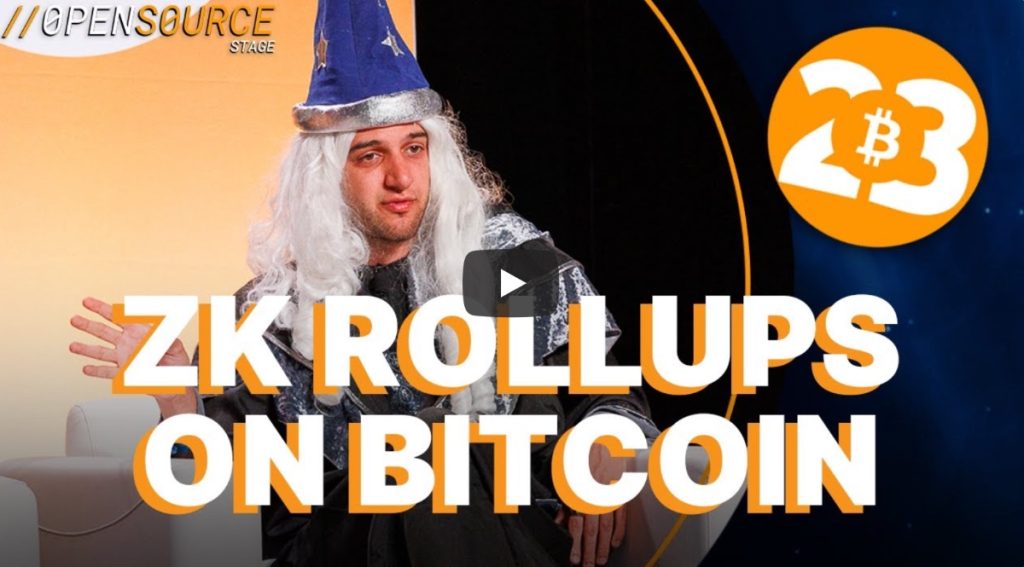
Learn more in this 2023 talk between Taproot Wizard Eric Wall and developer Preston Evans from Sovereign Labs.
What Steps Are Next?
Fully-fledged ZK-rollups on Bitcoin are not yet a reality. In order for them to be implemented and allow users to trustlessly bridge their BTC to and from the rollup, the Bitcoin protocol would need a soft fork (soft forks on Bitcoin don’t happen often, the most recent was Taproot in 2021). This new soft fork would add a new opcode: a new operation code or command in Bitcoin’s scripting language.
But developers are impatient and don’t want to wait years for a new opcode and soft fork. Two projects are currently leveraging the Ordinals Protocol to go around the need for a new opcode.
They are Chainway, which in early September 2023 announced the open-sourcing of their data availability (DA) adapter. This allows developers to build rollups with the Sovereign Software Development Kit (SDK). The adapter lets rollups use Bitcoin as their DA layer, something that wasn’t possible before. Data availability is crucial for rollups: it makes trustless verification of computations possible outside the main chain.
Another project with a similar approach is Kasar Labs. It teamed up with the infamous Taproot Wizards to release a DA adapter for Bitcoin around the same time as Chainway.
Conclusion
The mentioned projects are testing the ZK waters. We’ll have to wait and see if they will gain any traction. There’s already a sidechain to Bitcoin, Liquid, which doesn’t see large transaction volumes. But ZK-rollups bring more to the table without sacrificing decentralization. If the mentioned implementation of ZK rollups is a success, and if the community wants the full capabilities of ZK-rollups, Bitcoin would need a new opcode and soft fork. We’ll keep an eye on the developments.
 TOP RECOMMENDED CRYPTO SERVICES
  BINANCE: BEST EXCHANGE FOR BUYING CRYPTO IN THE WORLD
 10% OFF FEES & $600 BONUS
 BYBIT: #1 EXCHANGE FOR TRADING 0% SPOT FEES AND $4,450 IN BONUSES
 BEST CRYPTO WALLET TO KEEP YOUR ASSETS SAFE BUY LEDGER WALLET HERE
💻 BEST CRYPTO TAX SOFTWARE ON THE INTERNET GET COINLEDGER NOW
 BITGET: BITGET IS YOUR TICKET TO SEAMLESS AND REWARDING TRADING EXPERIENCES!
 $30,000 IN BONUSES